The Disruptive Futures Institute’s Proprietary Frameworks
One of the most recognized aspects of the Disruptive Futures Institute is its unique suite of frameworks, toolkits, and concepts.
These transdisciplinary methodologies form the foundation of our Executive Education Programs and are grounded in real-world examples. They help changemakers and organizations not just stay relevant - but thrive in an increasingly unpredictable world. Adopted by organizations worldwide, these methodologies have featured in leading publications such as the Journal of Futures Studies, MIT Technology Review, the Global Peter Drucker Forum, Dialogue (Duke Corporate Education), Fast Company, Risk.Net, the World Economic Forum, and more.
The Disruptive Futures Institute codifies, operationalizes, and advances its proprietary frameworks — including Metaruptions, the AAA Framework (Antifragile, Anticipatory, Agility), the Law of Inaction, and Techistentialism, developed by founder Roger Spitz — through its research centers, executive education, and board advisory. The Disruptive Futures Institute’s frameworks are adopted by boards, executive teams, and institutions worldwide to build anticipatory capacity and scale foresight across their organizations.

For too long, we spoke of tomorrow as something distant - yet tomorrow has arrived. The future is no longer an abstract horizon; it is unfolding now. What we once feared, what we once dreamed - it is here. We must now ask “What if this were to happen suddenly, right now?”
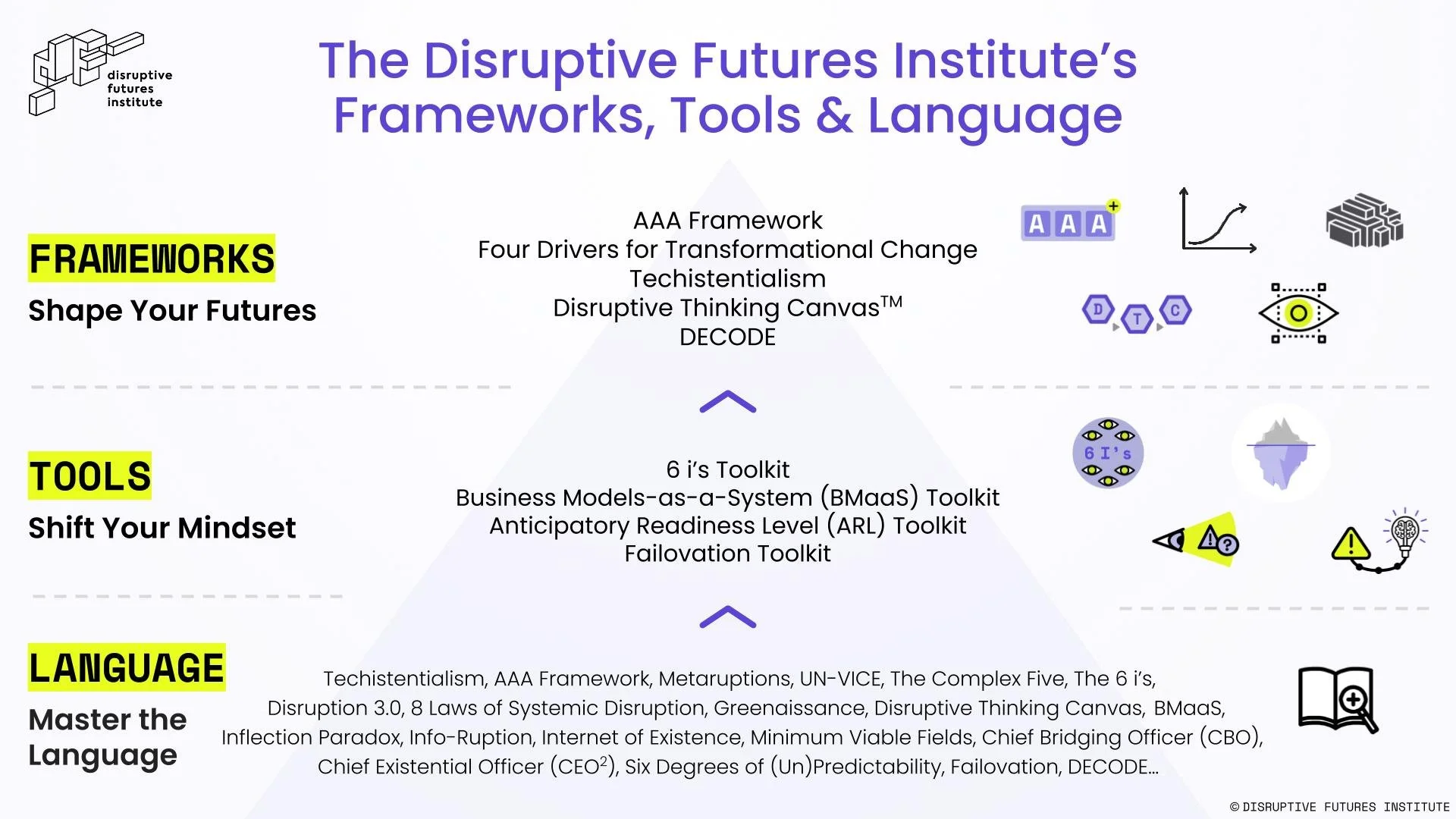
The Disruptive Futures Institute is helping to evolve the language and scope of the futures field, offering a comprehensive set of frameworks, methodologies, tools, language, and core concepts to help individuals and organizations shape resilient, transformative futures.
Through this work, we can shift mindsets, master the language of disruption and uncertainty, and build the capacity to navigate complexity, unpredictability, and change with confidence.
The Disruptive Futures Institute’s frameworks and tools were developed to address a widespread lack of resilience in today’s systems. Through our primary publications, the Disruptive Futures Institute has introduced a new lexicon and practical methodologies, crafted to shift mindsets and help redefine how we navigate uncertainty.
Now, we have consolidated and updated these ideas into a four-part article series, to provide an overview of our approach to systemic disruption.
In this four-part article series, we share an updated understanding of our work on systemic disruption in one convenient place - to enhance resilience and future-preparedness.
4-Part Article Series: Our Frameworks, Tools, and Language
Article 1: Executive Summary
Article 1 - Executive Summary
The Purpose and Impact of the Disruptive Futures Institute.
A high-level overview of its mission - and why its work matters now more than ever.
Article 2: Frameworks & Methodologies

Article 2 - Frameworks & Methodologies
An overview of the Disruptive Futures Institute’s proprietary FRAMEWORKS.
Designed to help you understand, anticipate, and navigate change.
Article 3: Tools & Toolkits

Article 3 - Toolkits
Practical, step-by-step TOOLS you can apply to your work and life.
While each toolkit stands alone, they support the broader frameworks.
Article 4: Language & Core Concepts

Article 4 - Language & Core Concepts
Defining the key terms and LANGUAGE that shape how we talk and act within this age of complexity.
Mastering updated language is essential for engaging with systemic disruption.
The Publications of the Disruptive Futures Institute

The Disruptive Futures Institute’s Publications Dive Deeper into these Frameworks
Given the overwhelming interest in our work, the responses to our many talks and programs, we decided to publish our unique frameworks and methodologies in two primary sets of publications:
First, the four-Volume Guidebook The Definitive Guide to Thriving on Disruption
Second, Disrupt With Impact: Achieve Business Success in an Unpredictable World
Volume II of The Definitive Guide to Thriving on Disruption is titled “Essential Frameworks for Disruption and Uncertainty”. Throughout this comprehensive Guidebook, Roger Spitz with Lidia Zuin present and apply a host of enhanced foresight frameworks and toolkits. Chapter 5, “Anticipatory: The Capacity to Prepare for Constant Disruption”, and Chapter 11, “Futures Frameworks & Foresight Fundamentals Workbook”, contain a particularly dense frequency of practical tools and frameworks, used by professional futurists to help us imagine and create the futures we desire.
Drawing on transdisciplinary insights - from futures studies and systems thinking to sustainable development and foresight strategy - these books serve as a trusted compass for staying relevant and resilient amid systemic change.

Metaruptions
How the Word Traveled
Since its coinage, Metaruptions has crossed languages and disciplines. The term now circulates in Japanese as メタラプション (Forbes Japan), in Brazilian Portuguese as “metadisrupções” (CNN Brasil, Estadão, MIT Technology Review Brasil), in French as “métaruptions,” and in Korean and Indonesian media. A Forbes contributor independently named “Metaruption” a 2026 Word of the Year, since translated by Forbes Japan.
Beyond media, the term has been referenced by the World Economic Forum, the International Training Centre of the UN’s International Labour Organization (ILO) — whose 2026 Futures Toolkit, focused on the future of work, opens with it — the UK National Preparedness Commission, the CFA Institute, IDOS (German Institute of Development and Sustainability), and the Association of Professional Futurists. The professions themselves are engaging with the term as they confront their own futures: the Institute and Faculty of Actuaries, the Institute of Chartered Accountants, the Institute of Directors in India, and the American Institute of Chemical Engineers (AIChE).
Metaruptions in Art
The word has even reached canvas: British artist Dylan Gill discovered Spitz’s term while searching for a title for his painting Metaruptions — the two later met for a broadcast conversation in London.
Read the Origin Story of Spitz’s Metaruptions
"We are past the point of simple volatility," says Spitz, Chair of the Disruptive Futures Institute. "As we enter the second half of the decade, we are navigating Metaruptions — deep, interconnected, transdisciplinary system shifts arising from technological, ecological, geopolitical, economic, and societal convergence."
Metaruption: The Birth of a New Word — Roger Spitz for L'Atelier des Futurs
Coined by Roger Spitz in 2019, Metaruptions identify the meta-layer where disruptions begin to disrupt the frameworks we use to understand change itself. They are value-neutral: breakdown or breakthrough depends on our agency, mindset, preparation, and response.
Metaruptions are a multidimensional family of systemic disruptions that generate widespread, self-perpetuating effects far beyond their initial domains — including a shift in the very notion of disruption itself.
The conceptual foundations of Roger Spitz’s Metaruptions were first published in the Journal of Futures Studies “The Future of Strategic Decision-Making” (2020), then formally codified and developed across the four-volume Definitive Guide to Thriving on Disruption and Disrupt With Impact. With each passing year of that codification, the world supplied more evidence.
Where Metaruptions Comes From: Primary References
Roger Spitz coined the term Metaruptions in 2019. The concept was first published in “The Future of Strategic Decision-Making” (Journal of Futures Studies, July 2020), then formally codified and developed across the four-volume Definitive Guide to Thriving on Disruption (Disruptive Futures Institute, 2022–2023) and Disrupt With Impact (Kogan Page, 2024). He has since defined, developed, and applied the concept across books, articles, keynotes, and media worldwide.
Selected publication record and metaruptions references:
Spitz, R. “The Future of Strategic Decision-Making.” Journal of Futures Studies, July 26, 2020.
Spitz, R., The Definitive Guide to Thriving on Disruption, Vols. I–IV. Disruptive Futures Institute: San Francisco, 2022–2023.
Spitz, R. The Definitive Guide to Thriving on Disruption: Vol. I. Reframing and Navigating Disruption. Disruptive Futures Institute: San Francisco, 2022.
Spitz, R., The Definitive Guide to Thriving on Disruption: Vol. II. Essential Frameworks for Disruption and Uncertainty. Disruptive Futures Institute: San Francisco, 2022.
Spitz, R. Disrupt With Impact: Achieve Business Success in an Unpredictable World. Kogan Page: London, 2024.
Spitz, R., and Choi, D. “Metaruption: Understanding the Complexities of a Disrupted World”. Homo Dongmicus, November 11, 2024.
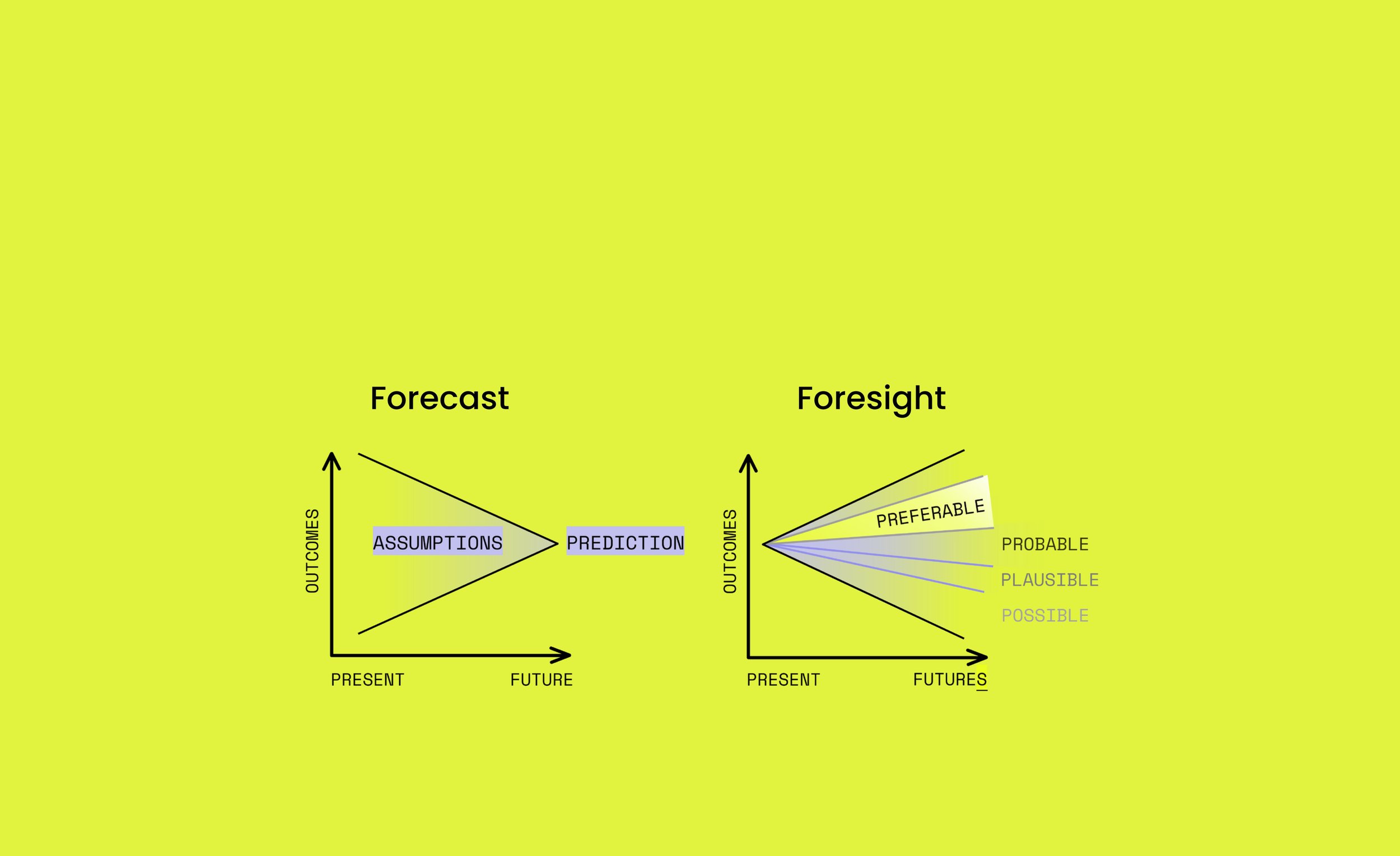
Spitz, R. “Why shifting from prediction to foresight can help us plan for future disruption.” World Economic Forum, May 3, 2024.
Spitz, R. “Polycrisis or Polyprepared? Welcome to Metaruptions”. Compass Magazine, April 2025: Welcome to the Polycrisis. Association of Professional Futurists (APF), April, 2025.
Spitz, R. “Foresight is Dead. Long Live Foresight.” Compass Magazine Special Edition, APF and the Global Futures Society (GFS), November 2025.
Spitz, R. “Policrise ou Polipreparação? Conheça as metadisrupções.” MIT Technology Review Brasil, August 26, 2025.
Spitz, R. “Creature discomforts: categorising risks amid deep uncertainty”. The Actuary, July 8, 2026.
Spitz, R. « Q339 · Métaruption : comment naît un mot ? ». Atelier des Futurs, July 12, 2026.
Spitz, R. “Q339 · Metaruption: The Birth of a New Word”. Atelier des Futurs, July 12, 2026.
The AAA Framework

The AAA Framework
Metaruptions demand more than resilience. The AAA Framework equips individuals and organizations to stay relevant and create value amid systemic disruption — not by predicting what comes next, but by building the capacity to respond as conditions reconfigure.
Antifragile — foundations that don't merely withstand volatility but gain from it, converting shocks into optionality.
Anticipatory — scanning weak signals, questioning assumptions, and exploring the next-order implications of change rather than betting on a single predicted future.
Agility — the cognitive, emergent and strategic flexibility to bridge long-term vision with real-time decision-making.
Introduced in Spitz’s "The Future of Strategic Decision-Making" (Journal of Futures Studies, 2020) and developed across The Definitive Guide to Thriving on Disruption and Disrupt With Impact, the framework has since been applied by boards, institutions, and governments — including a World Economic Forum Global Foresight Network case study on transforming carbon markets.
In the books, we extend the model into AAA+, adding Agency and Alignment: Agency, because in an age of algorithmic decision-making, preserving human choice is itself a capability; Alignment, because antifragile, anticipatory, agile systems still need a shared direction to pull toward.

Agency is the choice you make.
Inaction is the choice that makes you.
Eight Interconnected Principles
The Law of Inaction sets out eight interconnected principles describing how inaction operates and compounds at every scale, from the individual to the civilizational. A few illustrate the range:
Always deciding: not deciding is itself a decision, as identity-defining as any deliberate act.
Agency expires: an option unexercised lapses, and others act in your place.
Collapsing cost: it has never been cheaper to experiment, or costlier to wait.
The remaining principles trace how inaction compounds nonlinearly, why it stays invisible until the window has closed, where the line runs between recoverable and irreversible, and when inertia becomes existential — developed in full in Roger Spitz’s forthcoming work.
The Line Between Reversible and Irreversible
Not all inaction is equal. Where choices remain reversible, the cost is real but recoverable — opportunity cost, missed experimentation, ground ceded but reclaimable. Where inaction crosses into irreversible territory, the calculus changes entirely: a capability never built, a transition missed, a window of transformation that closed while deliberation continued. These cannot be recovered by later action at equal cost.
Most organizations never locate the line until they have already crossed it. The window does not close abruptly; it narrows until the crossing has already happened.
Law of Inaction
The futures are open — until they aren’t. Inaction is never neutral.
Defining the Law of Inaction
The Law of Inaction, developed by futurist Roger Spitz, holds that inaction is never neutral: every silence is a decision whose costs and forgone opportunities compound over time. Its eight interconnected principles describe how deferral forecloses futures at every scale, from the individual to the civilizational — the inverse instrument to agency, tracing what accumulates when the capacity to choose goes unexercised.
Strategic thinking long treated inaction as neutral stillness — a way to preserve options while the world waited. In a complex, nonlinear, and deeply uncertain world, that option has expired. Standing still is a decision with compounding consequences.
If agency is what you exercise, inaction is what exercises you when you do not — and it rarely announces itself. Every choice you don’t make is still made — by time, by others, by default.
Law of Inaction: Origin & Recent Features
The Law of Inaction extends Roger Spitz’s decade of work on agency and decision-making under deep uncertainty — the through-line running from Techistentialism through his seminal 2020 paper, “The Future of Strategic Decision-Making” (Journal of Futures Studies), and into the Metaruptions framework. Where Metaruptions describe the environment, the Law of Inaction describes what that environment does to those who defer.
Underlying ideas of the Law of Inaction have featured recently — including at the World Economic Forum and MIT Technology Review Brasil — while Roger Spitz and the Disruptive Futures Institute continue to develop, formalize, and operationalize the full framework, with applied case studies, for forthcoming publications and further executive education programs.
The Law of Inaction: How doing nothing can impact our future, multiple times over (Roger Spitz, World Economic Forum, Forum Stories, July 29, 2026)
A Lei da Inação: o futuro está em aberto. Até não estar mais (Roger Spitz, MIT Technology Review Brasil, June 23, 2026)
The futures are open. The Law of Inaction is the instrument for calibrating that window — before it closes.

“One of Spitz’s most urgent messages is the need to become AAA: Anticipatory, Antifragile, and Agile. The AAA framework encourages governments, businesses, schools, and individuals to transform their traditional decision-making paradigms amid ongoing disruption.”
– Association of Professional Futurists, Compass Magazine
Techistentialism

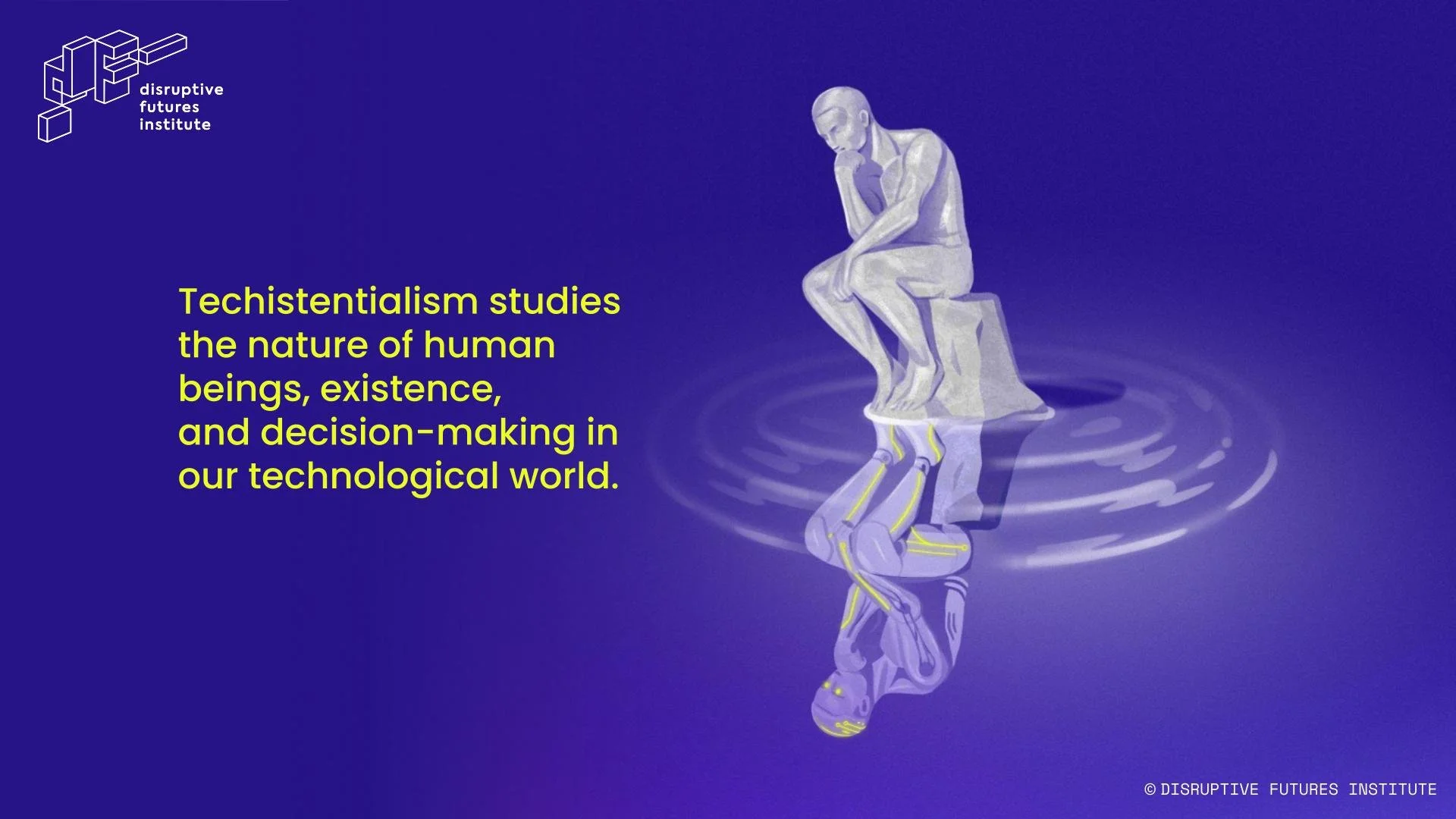
Techistentialism, a play on the terms technology and existential, studies the nature of human beings, existence, and decision-making in our technological world. Today, we face both technological and existential conditions that can no longer be separated. We define this phenomenon as Techistentialism.
Techistentialism broadens the definition of technology’s “existential risks” to include the curtailment of human agency. This brings the discussion back to a core meaning of “existential,” beyond physical threats, to consider the deep importance of meaningful human autonomy. Instead of treating AI primarily as a speculative future danger,
Techistentialism also focuses on immediate, human-centric vulnerabilities, advocating for the cultivation of human capabilities - Antifragile, Anticipatory, and Agility - as essential for relevance in the 21st century.
The Disruptive Thinking Canvas

Our Disruptive Thinking Canvas™ is a tool for inventing your futures, a personalized roadmap designed to help you thrive in today’s shifting environments. By identifying unexplored opportunities, you can invent the future, whether for yourself, your projects, or your organization. The Disruptive Thinking Canvas offers a step-by-step guide to navigate disruption and create impact, equipping you with the mindset and tools needed to succeed.


“Their Disruptive Thinking Canvas is an essential practice all organizations need to employ if they want to shape the future with impact and be around to see it.”
– Kara Cunzeman, Director of Strategic Foresight at the Aerospace Corporation, Chair of the Federal Foresight Advocacy Alliance
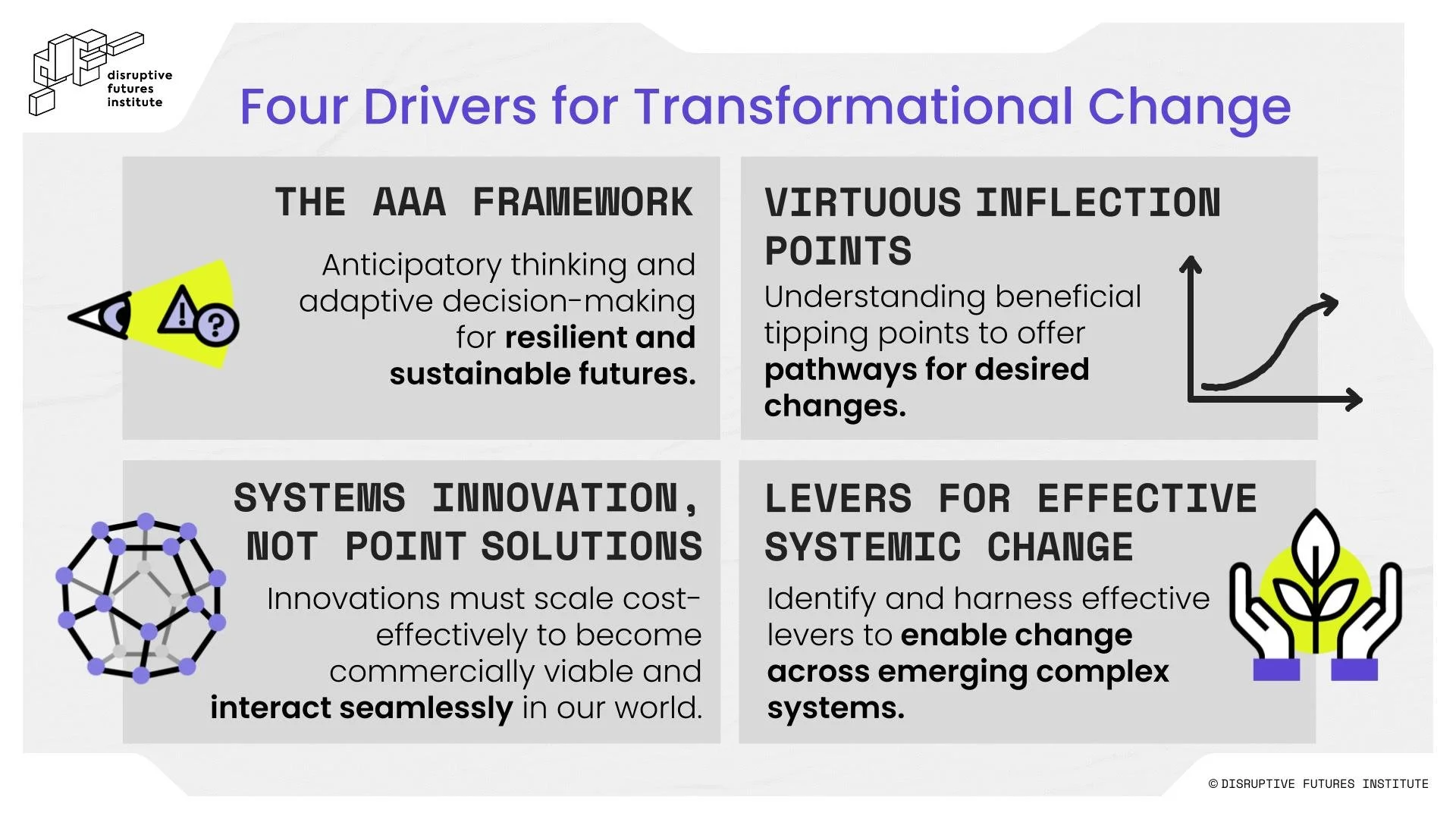
Four Drivers for Transformational Change

The Four Drivers for Transformational Change are four related mindsets and actions that can lead to systems-level transformative change:
Enhance strategic foresight with the AAA Framework: Anticipatory thinking and adaptive decision-making for resilient and sustainable futures.
Create virtuous inflection points: Understanding beneficial tipping points to offer pathways for desired changes.
Catalyze systems innovation instead of focusing on point solutions: Innovations must scale cost-effectively to become commercially viable and interact seamlessly in the real world.
Harness the levers for effective systemic change: Identify and harness effective levers to enable change across emerging complex systems.

“[Roger Spitz] challenges leaders to consider the broader impact of their actions on society and the environment, advocating for a systemic approach to innovation that advances sustainable value creation.”
– Chris Mayer, Director of Philosophy, United States Military Academy at West Point, Futures Empowered

“Our loss of agency needs to be analyzed through a philosophical lens so that we can better understand ourselves in a world dominated by tech.”
– Noah Ackland, “Predicting the Unpredictable in Business with Roger Spitz”, Hult International Business School Blog
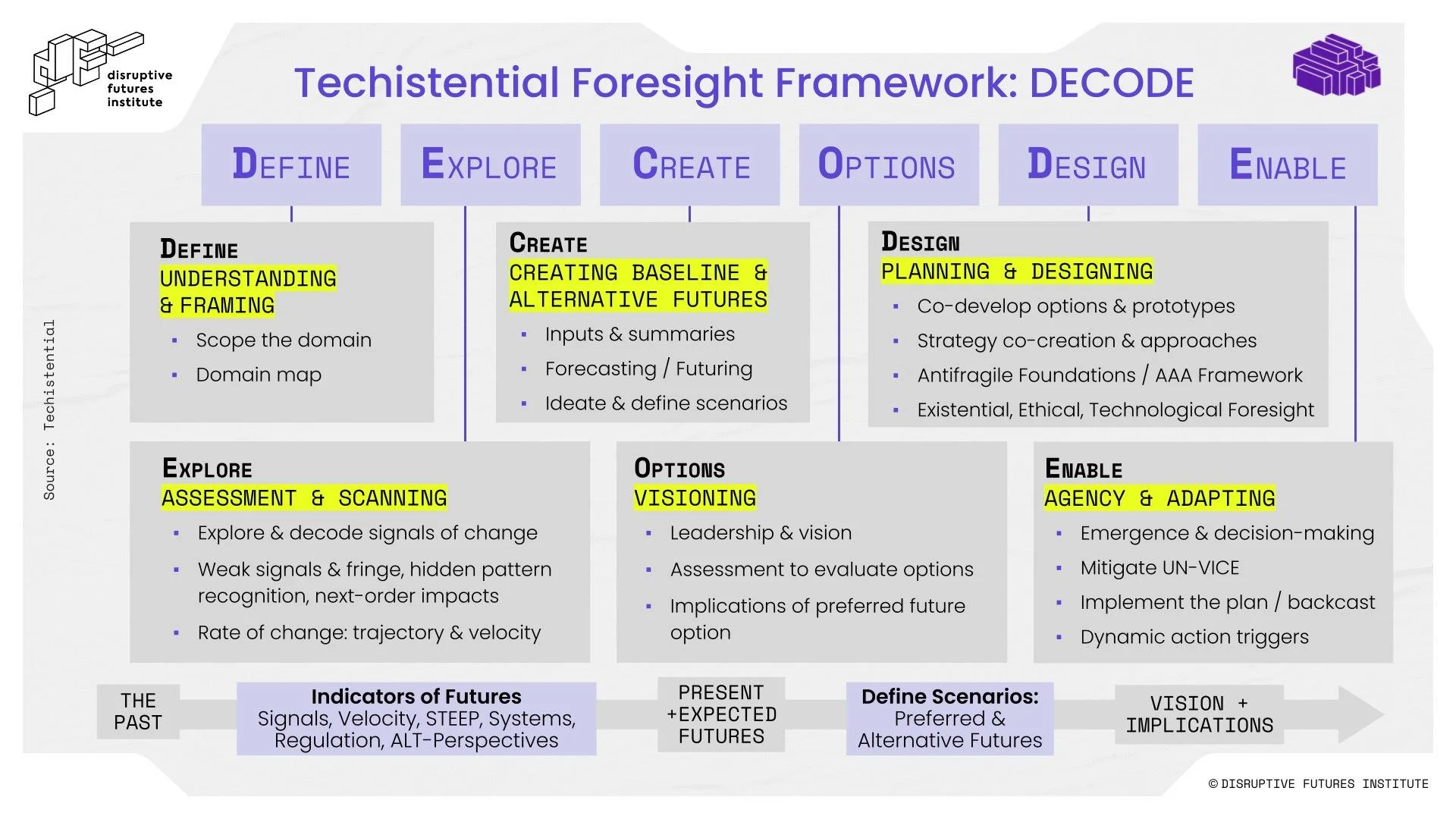
DECODE, Techistential’s Foresight Framework

Techistential’s Foresight Framework (DECODE) is designed to help explore signals of change (including weak signals at the fringe, scanning, and emerging issues), uncover patterns, calibrate the dimensions of uncertainty, probability, and risk, and think in different time horizons.
While the future is not knowable, DECODE can help us structure our vision of possible futures, imagine evolutions or pathways, and connect the shifting dots to develop more anticipatory mindsets.
The Six Steps of DECODE:
(i) Define: Understanding & Framing
(ii) Explore: Assessment & Scanning
(iii) Create: Creating Baseline & Alternative Futures
(iv) Option: Visioning
(v) Design: Planning & Designing
(vi) Enable: Agency & Adapting
Upon successful completion of our global education programs, the Disruptive Futures Institute confers proprietary certificates that demonstrate mastery of the material.
